Brands are discovering a quiet imbalance in social media. While human influencers are still building audiences one post at a time, AI influencers are scaling at a speed that traditional creator models cannot match. They publish constantly, adapt instantly to trends, and operate without burnout, scheduling gaps, or personal constraints. For companies that rely on influence to drive awareness and sales, this shift is not about novelty. It is about control, efficiency, and the future structure of brand-led storytelling in a world where artificial intelligence models can now perform at influencer scale.
This acceleration is forcing brands to rethink how influence works. The question is no longer whether AI influencers will coexist with humans. The real question is how brands should respond when AI-powered personas can outproduce, out-test, and out-optimize human creators across platforms.
How AI Influencers Scale so Rapidly?
The core advantage of AI influencers lies in the combination of automation and intelligence. AI modeling systems can generate visuals, captions, short videos, and responses in a continuous manner. They are not limited by time zones, energy levels, or creative fatigue. Artificial intelligence models analyze platform data in real time, adjusting tone, posting schedules, and formats based on engagement signals almost instantly.
Human influencers, by contrast, scale linearly. Growth requires more time, more effort, and often more people. AI influencers scale exponentially because production, optimization, and iteration happen simultaneously. This makes them attractive to brands that prioritize speed, consistency, and performance testing.
From a business perspective, this is less about replacing people and more about changing the economics of influence. When output becomes unlimited, influence becomes programmable.
The Appeal of AI Influencers for Brands
For brands, AI influencers offer predictability. They stay on message. They never go off-brand. They do not create reputational risk through personal controversy. Every interaction can be logged, reviewed, and optimized.
This level of control is difficult to achieve with human creators, whose authenticity is also their unpredictability. AI influencers allow brands to simulate personality without surrendering governance. Artificial intelligence models can be trained to reflect brand values, aesthetics, and tone with precision.
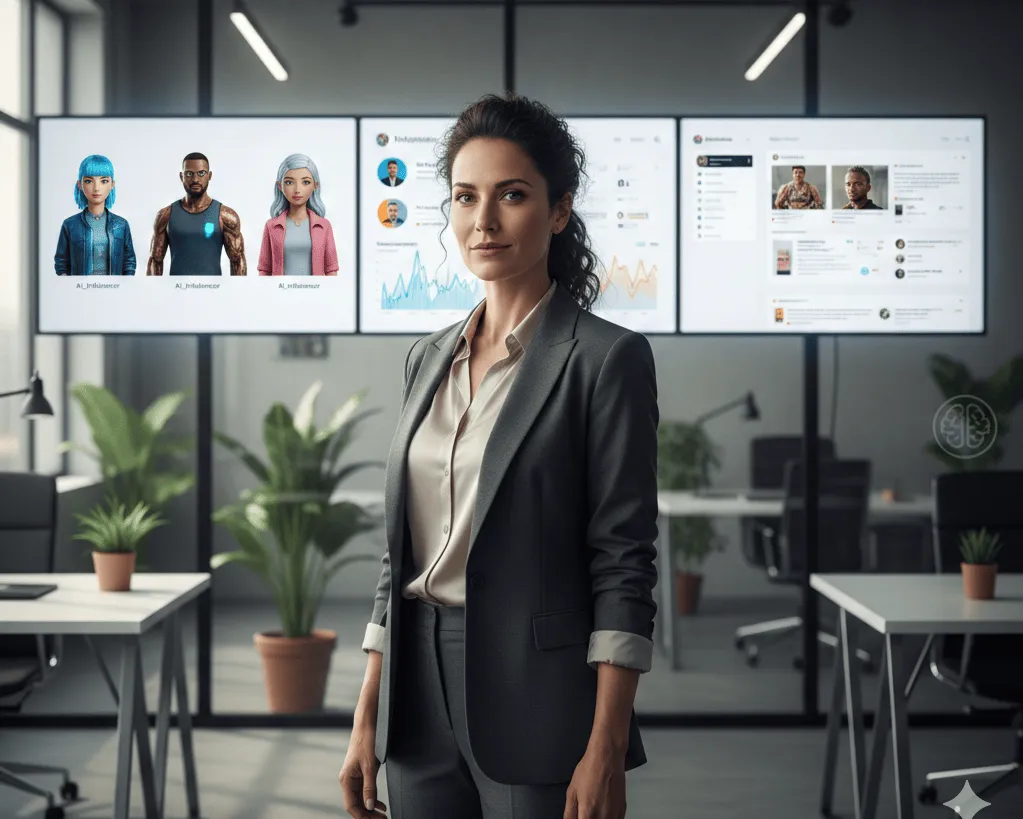
This explains why brands in fashion, gaming, beauty, and digital services are experimenting with AI-led influencer campaigns. These virtual personalities can appear across platforms simultaneously, localized for different markets, and updated continuously without renegotiating contracts or managing individual relationships.
Human Influencers Still Hold Power
Despite their scalability, AI influencers face a fundamental limitation. They do not live real lives. Audiences still connect deeply with human experience, especially in spaces where trust, vulnerability, or expertise matter.
Human influencers create influence through narrative, not just output. Their mistakes, growth, and opinions build emotional investment. This is especially important in industries like health, education, finance, and long-term lifestyle branding.
Brands that rely solely on AI influencers risk achieving reach without resonance. Engagement metrics may look strong, but loyalty can remain shallow. Human creators still anchor credibility because people recognize lived experience, even when AI-generated content looks polished.
Rising Trend: Hybrid Influencer Brands
The most effective strategy emerging is hybrid influence. In this model, human creators use AI modeling tools to amplify their presence rather than replace it. AI assists with scripting, editing, scheduling, and analytics, while humans provide voice, judgment, and authenticity.
Hybrid brands scale faster than purely human creators while retaining trust. A single influencer can operate multiple content streams, respond to audiences around the clock, and adapt to platform changes without losing personal identity. Artificial intelligence models handle repetition and optimization. Humans focus on perspective and connection.
For brands, hybrid influencers offer the best of both worlds. They combine the reliability of AI systems with the credibility of human storytelling. This balance is increasingly attractive as audiences grow more skeptical of content that feels fully automated.
Audience Perception is Shifting
Audiences are becoming more aware of AI-generated content, even when it is not explicitly labeled. Patterns repeat. Visual styles converge. Narration tones sound familiar. This awareness changes how people evaluate influence.
Some viewers enjoy AI influencers as entertainment. Others see them as tools rather than personalities. This distinction matters. Influence depends on perceived intent. When content feels engineered rather than expressed, audiences engage differently.
Brands must understand this nuance. AI influencers can drive awareness and experimentation, but human trust remains essential for long-term brand equity. Hybrid strategies help bridge this gap by keeping a human presence at the center of the narrative.
Influencer Marketing is Changing
AI influencers scaling faster than humans change how brands allocate budgets. Instead of paying for individual reach, companies invest in systems that can test, iterate, and refine messaging continuously. Campaigns become ongoing processes rather than one-off partnerships.
This also changes how success is measured. Performance data becomes more granular. Messaging evolves in near real time. Artificial intelligence models optimize not just content but strategy.
However, brands that chase efficiency alone risk eroding differentiation. When everyone uses similar AI tools, content sameness increases. Strategic oversight becomes critical. AI should accelerate brand expression, not flatten it.
Regulation, Transparency, and Trust

As AI influencers become more common, transparency will matter more. Audiences expect clarity about whether a persona is human, AI, or hybrid. Regulatory bodies are already examining disclosure standards around synthetic media and endorsements.
Brands that proactively disclose AI involvement are more likely to maintain trust. The goal is not to hide automation but to integrate it responsibly. Trust is fragile in influence-based marketing, and artificial intelligence amplifies both opportunity and risk.
What the Future Holds for Brands?
AI influencers will continue to scale faster than humans. That trend is irreversible. What is still undecided is how brands choose to use them.
The future of influence will not be fully human or fully artificial. It will be layered. Human creators will become directors of AI-assisted systems. AI personas will handle scale and experimentation. Hybrid brands will dominate because they balance efficiency with credibility.
Brands that succeed will treat artificial intelligence models as infrastructure, not identity. They will invest in human voice while leveraging AI for reach and optimization. Those that rely purely on automation may win attention temporarily but struggle to build lasting influence.
Aidgtal Perspective
AI influencers scaling faster than humans are not a threat to influence. It is a redefinition of it. Influence is moving from individual output to system design. Brands that understand this shift early will gain a strategic advantage.
In a crowded digital landscape, speed matters, but meaning matters more. Artificial intelligence can multiply presence, but trust still comes from human intention. The brands that thrive will be the ones that learn how to combine both without losing either.