
I’ve spent the better part of a decade working with startups, and there’s always been this unspoken rule: serious companies need serious teams. You’d plan your Series A around hiring a VP of Marketing. You’d budget for a customer success team before you even had product-market fit. That’s just how it worked. Except now it doesn’t. Something fundamental has shifted in the last two years, and I keep seeing it play out across the US startup scene. Solo founders are running what look like full-scale operations without the traditional infrastructure. We’re talking real revenue, global customers, professional brands, the works. And they’re doing it alone, or close to it.
The difference? They’ve figured out how to build a one-person company with AI that actually functions like a multi-department organization. Not in some theoretical, VC pitch deck kind of way. In practice, generating revenue, serving customers across time zones, and competing against funded teams.
Math Just Stopped Making Sense
Here’s what changed. Hiring in the US tech scene has become absurdly expensive and painfully slow. You’re looking at six figures for a decent marketer, another six figures for someone to handle customer success, and that’s before you factor in equity, benefits, and the three months it takes to actually get someone productive. Meanwhile, your competitor, the solo founder with the right AI stack, is already testing five different marketing angles and has automated onboarding running 24/7.
I’m not saying AI makes teams obsolete. But it’s made the default assumption that you need a team to scale, well, questionable. The one-person company with an AI model isn’t a lifestyle business anymore. It’s becoming a legitimate competitive strategy, especially in SaaS, where software scales naturally anyway.
What AI Actually Replaces (Hint: Not You)
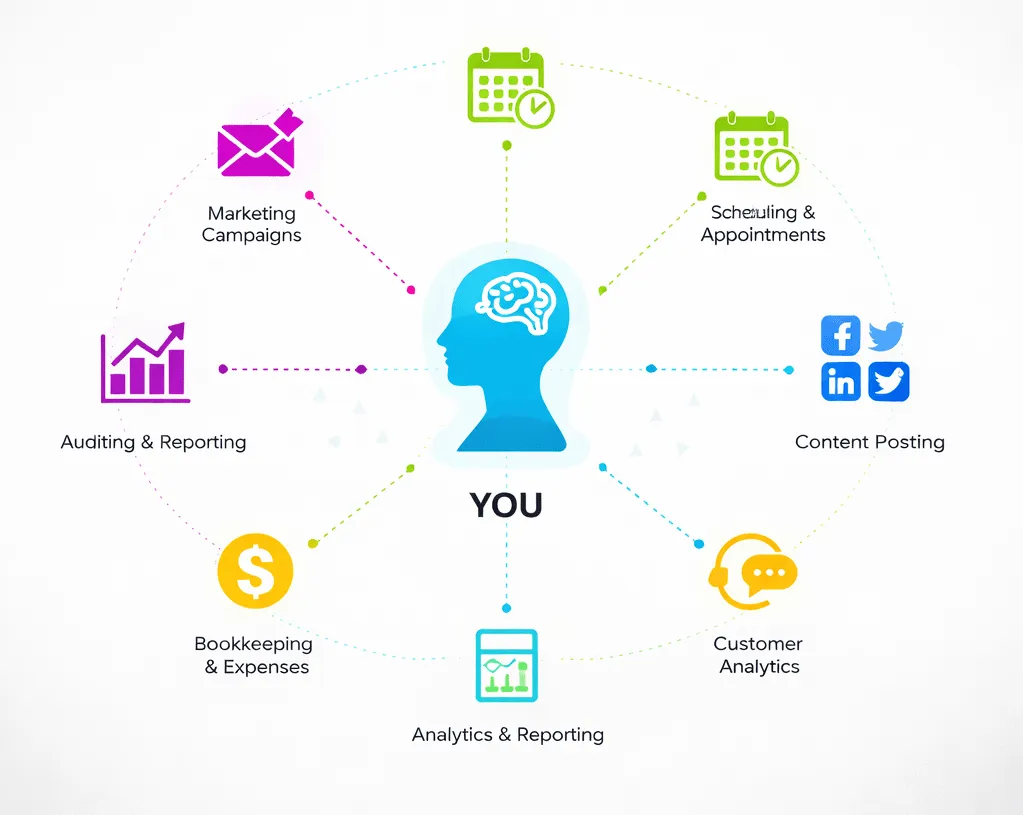
Let’s be clear about what’s happening here. AI doesn’t replace the founder. It can’t make the strategic calls, feel out market fit, or decide what the brand should stand for. What it does replace is the departmental layer beneath those decisions.
Take content production. Used to be, if you wanted to maintain a consistent publishing schedule across multiple channels, you needed writers, editors, maybe a designer. Now? A solo founder can handle that volume with AI-assisted writing and design tools, keeping the brand voice consistent while actually scaling output. For SaaS companies and creator-led brands where visibility directly impacts growth, that’s not a nice-to-have. It’s table stakes.
Customer support followed a similar trajectory, though it took a bit longer. Modern AI chat systems can handle the routine stuff, such as password resets, basic troubleshooting, and explaining features that are already documented. They escalate the complex issues. Your customers get responses at 2 AM. You don’t burn out answering the same question forty times a week. Everyone wins.
The pattern here is pretty straightforward: founders scale AI systems to handle volume and repetition, then focus their own time on the things that actually require human judgment. Strategic direction. Quality control. The decisions that determine whether the company succeeds or fails.
Advantage of Solo Founder
One of the weirder advantages of this model, and honestly, one I didn’t see coming, is how it eliminates geographic constraints. Time zones used to require regional teams. Language barriers meant hiring translators or limiting your market. Operational delays were just part of doing international business.
Not anymore. AI systems don’t sleep, don’t take weekends off, and can communicate in dozens of languages without thinking about it. A solo founder in Austin or San Francisco can sell to customers in Europe, support users in Asia, analyze performance data from South America, and adjust strategy before lunch.
For SaaS founders, especially, this is kind of absurd. Your infrastructure scales automatically through cloud hosting. Onboarding is automated. Marketing funnels run themselves. Analytics surface insights without you building manual reports. You end up spending your time on product vision and strategic positioning rather than operational execution. Which, let’s be honest, is what you should have been doing all along.
When Creators Realized They Could Be Companies?
The creator economy saw this shift earlier than most, probably because creators already owned their distribution. They had the audience, they had the attention. What they didn’t have was operational depth. Running a merchandise operation, managing email sequences, handling customer service for digital products, that stuff was either expensive to outsource or time-consuming to DIY.
AI changed the equation. Now, a creator can launch products, manage sophisticated email marketing, handle customer engagement, and run monetization systems without hiring anyone. Creators becoming corporations isn’t just a catchy phrase. It’s a functional reality. One person can operate what looks like a media company, a software business, and a customer service department simultaneously.
The ones who figure out how to scale AI alongside their audience are building real businesses, not just riding attention cycles. There’s actual infrastructure underneath now, which means there’s durability.
Why SaaS Is Perfect for a Solo Founder Concept?
SaaS was always going to be the ideal testing ground for one-person AI companies, and the reason is pretty simple: software scales naturally. You’re not manufacturing physical products. You’re not managing inventory. Once you’ve built the product, serving one customer or one thousand customers doesn’t require proportionally more effort.
When you layer AI on top of that inherent scalability, AI handling customer success workflows, communicating new features, analyzing usage patterns, triaging support tickets, you free up the founder to focus exclusively on product development and market fit. And that creates a pretty interesting competitive advantage.
Solo SaaS founders can iterate faster than funded teams, who have to coordinate across departments. Decisions happen immediately. Experiments cost almost nothing. Feedback loops are tight. In markets where speed determines survival, being smaller isn’t a weakness. It’sa structural advantage.
Parts That Don’t Work Automatically
Look, I’d be doing you a disservice if I made this sound effortless. It’s not. AI systems require thoughtful setup, ongoing refinement, and ethical oversight. Poorly configured automation can torch customer trust faster than any human mistake ever could.
The solo founders who make this work treat AI as an amplifier, not a replacement for judgment. They stay deeply involved in brand voice, customer experience, and strategic direction. The AI executes, but humans still decide. That distinction matters more than people think.
There are also real constraints around regulation, data privacy, and intellectual property. As you scale artificial intelligence into more parts of your operation, your responsibility scales with it. Trust remains fundamentally a human obligation. You can’t automate your way out of that.
The Shift Nobody Talks About
Traditional growth meant asking, “Who should I hire next?” AI-driven growth means asking “which system should I improve next?” That’s a harder mental shift than it sounds, especially for founders trained in conventional startup thinking.
Instead of managing performance reviews, you’re refining prompts. No more running team meetings, you’re optimizing workflows. Instead of building an organizational structure, you’re designing decision rules. Growth becomes architectural rather than managerial. It requires a different skill set and, honestly, a different mindset.
Some founders adapt to this naturally. Others struggle with it, and there’s no shame in that. But if you want to run a one-person company with AI at scale, this is the adjustment you have to make.
Where This Go Next?
The idea of a one-person unicorn used to sound absurd. Now it just sounds… possible? Maybe even likely? As AI systems get more autonomous and better at working together, the gap between individual ambition and institutional scale keeps shrinking.
The most successful founders of the next decade might not run companies in the traditional sense. They’ll run ecosystems of AI systems, guided by clear vision and strong ethical frameworks. Creators becoming corporations isn’t a trend that peaks and fades. It’s a structural shift in how businesses get built.
A solo founder with the right AI stack can compete globally, move faster than teams, and build brands that punch way above their weight. The future probably doesn’t belong to the biggest organizations. It belongs to the smartest ones. And sometimes, the smartest organization is just one person who figured out which systems to build.