Artificial intelligence no longer belongs only to research labs or Silicon Valley giants. It now sits inside everyday business systems, quietly reshaping how companies operate, build products, serve customers, and compete. From retail and logistics to finance and marketing, organizations across the United States are discovering that understanding how AI is used in business is no longer optional. It has become a core requirement for staying relevant.
What once looked experimental now feels operational. Executives increasingly treat artificial intelligence in business as infrastructure rather than innovation theater. The shift is subtle but decisive. AI is not replacing leadership or strategy, but it is rapidly changing the mechanics underneath nearly every department.
How Enterprise AI Adoption Evolved from Experiment to Essential?
For much of the last decade, AI initiatives lived on innovation roadmaps rather than inside day-to-day workflows. That changed as cloud computing matured, data pipelines improved, and generative models made advanced capabilities accessible to nontechnical teams. According to a 2026 McKinsey report, 72% of enterprises now use AI in at least one business function, up from 50% in 2023, a clear signal that artificial intelligence has moved from experimental to essential.
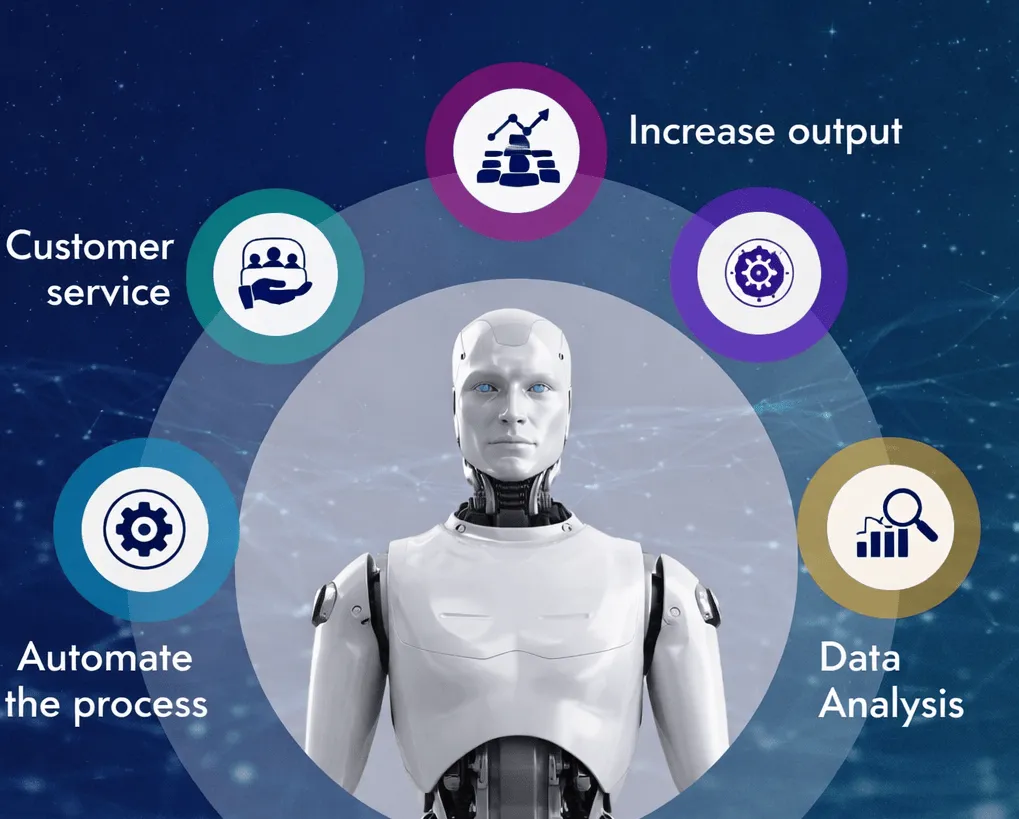
Today, enterprise AI adoption focuses less on novelty and more on measurable outcomes. Companies deploy AI automation tools to reduce support workloads, optimize supply chains, forecast demand, detect fraud, personalize marketing, and accelerate software development. These systems run continuously in the background, augmenting teams rather than displacing them.
The most successful organizations treat AI for operations the way they once treated ERP systems or analytics platforms. It becomes part of the operating fabric rather than a side project.
How AI Is Used in Business Functions Right Now?

Across industries, similar patterns appear in how machine learning in business delivers value.
In customer service, conversational systems handle common inquiries, route tickets intelligently, and surface relevant knowledge for human agents. Retailers and SaaS firms use AI customer service platforms to keep response times low while controlling staffing costs. Companies implementing AI-powered customer service report a 30-40% reduction in response times while maintaining satisfaction scores, demonstrating that automation can improve both efficiency and customer experience simultaneously.
Finance teams rely on predictive models to flag anomalies, improve cash-flow forecasting, and assess credit risk. In procurement and logistics, algorithms monitor inventory levels, negotiate shipping routes, and anticipate demand spikes before they disrupt operations. A recent Gartner study found that businesses using AI for demand forecasting reduce inventory costs by 20-50%, turning supply chain optimization from reactive firefighting into proactive planning.
Marketing departments increasingly use generative AI for companies to draft campaign concepts, test messaging, personalize email sequences, and analyze performance data at scale. Product teams embed AI product development tools to speed prototyping, identify usage patterns, and automate testing.
Each deployment may seem narrow in isolation, but together they form a network of business process automation that compounds efficiency across the organization.
How AI Business Strategy Creates Lasting Competitive Advantage?
The real power of artificial intelligence in business lies not in individual features but in cumulative leverage. AI systems never sleep, analyze far more data than humans can process, and improve continuously as they ingest new information. When companies integrate those capabilities across departments, decision cycles compress, and experimentation accelerates.
Research from Boston Consulting Group shows that companies with mature AI implementations achieve 3-5% higher revenue growth and 4-6% better profit margins compared to industry peers. When companies integrate those capabilities across departments, decision cycles compress, and experimentation accelerates.
Smaller firms benefit just as much as large enterprises. Startups use AI automation tools to run leaner operations, reach customers globally, and compete with incumbents that once relied on sheer headcount. Established corporations use enterprise AI adoption to modernize legacy workflows without rebuilding entire systems from scratch.
In both cases, AI shifts competitive dynamics toward organizations that move quickly, learn faster, and allocate human talent to high-judgment work instead of routine execution.
Building an Effective AI Business Strategy: Planning Over Tools
Despite the hype, AI business strategy matters far more than model size or vendor choice. Companies that rush deployment without governance, oversight, or clear objectives often struggle to produce sustained results.
Successful leaders start with questions such as: Which processes consume the most time? Where do errors or delays occur? Which decisions depend heavily on pattern recognition or forecasting? These answers guide responsible implementation far better than chasing trends.
They also invest in data quality, security, and training. Artificial intelligence in business only performs as well as the information it receives and the constraints placed around it. Human oversight remains central, particularly in regulated industries or customer-facing applications where trust and accountability define brand reputation.
How Generative AI for Companies Accelerates Productivity?

The arrival of generative systems has accelerated adoption across creative and knowledge-intensive roles. Writers, analysts, designers, developers, and marketers increasingly treat AI as a first draft partner or analytical assistant rather than a replacement.
This shift has tangible economic effects. Teams publish content faster, ship software more quickly, respond to customers more consistently, and test new ideas with lower risk. Over time, that speed advantage compounds into market leadership.
Generative AI for companies works best when paired with human judgment. Professionals shape goals, evaluate outputs, and make final calls. The technology removes friction from execution, not responsibility from leadership.
AI Business Strategy: Managing Risks, Compliance, and Ethics
As AI spreads deeper into operations, scrutiny grows. Data privacy, intellectual property, bias, and explainability all influence how organizations deploy systems at scale. Regulators increasingly expect transparency around automated decision making, especially in finance, hiring, insurance, and healthcare.
Forward-looking companies embed governance frameworks early rather than retrofitting them later. They document training sources, audit outputs, establish escalation paths, and maintain human review for high-impact decisions. This approach not only reduces legal risk but also builds customer confidence.
Responsible artificial intelligence in business has become part of brand identity. Trust now functions as a competitive asset alongside efficiency.
The Aidgtal’s View on AI in Business
Looking ahead, AI will fade into the background of most workflows in the same way cloud computing once did. Employees may no longer think about “using AI” explicitly. They will simply rely on systems that forecast demand, summarize meetings, detect anomalies, personalize experiences, and automate administrative work.
Companies that succeed in this environment will not be those with the flashiest pilots, but those that integrate machine learning in business steadily, ethically, and strategically across functions.
Look at how AI is used in business today, and you’ll see tomorrow’s standard operating model taking shape. The organizations building these capabilities now are shaping cost structures, customer expectations, and competitive barriers that others will struggle to match later.
Artificial intelligence is no longer an experiment on the edge of enterprise strategy. It is becoming the quiet engine underneath modern commerce.
AI automates routine tasks like data entry, customer support ticket routing, and inventory management, freeing teams for strategic work.
Yes, small businesses increasingly use AI automation tools like chatbots, email marketing platforms, and accounting software with built-in AI features.
Costs range from free tiers on platforms like ChatGPT to enterprise solutions costing $50,000+ annually, depending on scale and complexity.
AI augments human work rather than replacing it, automating routine tasks while creating demand for AI oversight, strategy, and implementation roles.