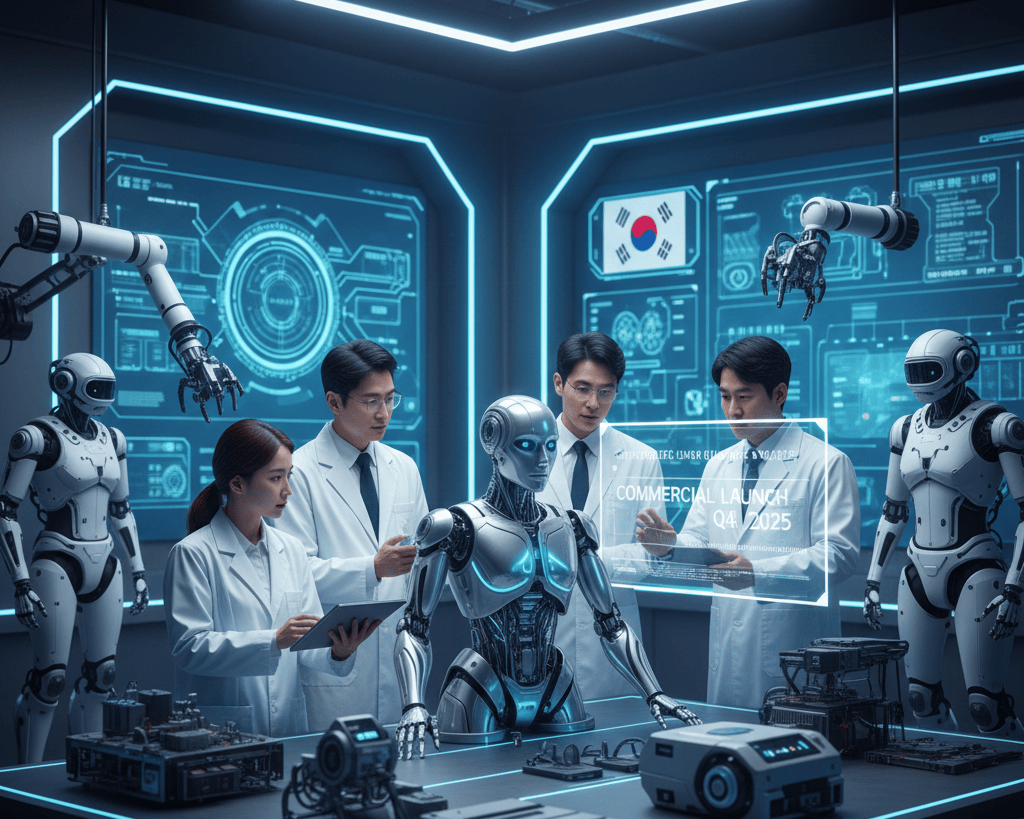
South Korea is moving closer to commercial deployment of physical AI devices, as manufacturers and research institutions prepare robots and task-specific systems for near-term market entry. These developments reflect coordinated efforts across industry, academia, and government to translate artificial intelligence research into deployable hardware.
Physical AI, which combines machine learning with sensors, robotics, and real-world actuation, is becoming a strategic focus for Korean technology firms seeking to scale automation beyond software-only applications.
Industrial Robots and Task-Specific AI Systems
Korean manufacturers are finalizing physical AI devices designed for defined industrial and service tasks. These include collaborative robots for manufacturing, logistics automation units for warehouses, and service robots for healthcare and retail environments. The systems integrate computer vision, speech recognition, and motion planning to perform repeatable tasks with minimal human intervention.
Several firms have confirmed that their devices are entering final testing and certification phases. These steps are required before commercial sales can begin, particularly in regulated sectors such as healthcare and public infrastructure. Unlike experimental robotics, the current generation is optimized for reliability, safety, and cost efficiency, which are key factors for enterprise adoption.
Government and Research Support Accelerates Deployment
South Korea’s government has played a significant role in advancing physical AI readiness. Public funding programs support pilot deployments, safety validation, and interoperability standards. National research institutes are working with private companies to ensure that AI models used in physical systems meet performance and compliance requirements.
Universities and applied research centers are also contributing by transferring robotics and AI research into commercial prototypes. These collaborations help shorten development cycles and reduce barriers between laboratory innovation and real-world use. The result is a pipeline of devices designed specifically for production environments rather than experimental demonstrations.
Focus on Manufacturing, Healthcare, and Urban Services
Manufacturing remains the primary sector for early commercialization. Korean factories are adopting AI-powered robots that can adapt to variations in assembly tasks and improve efficiency without extensive reprogramming. These systems are particularly relevant for small and mid-sized manufacturers facing labor shortages.
Healthcare applications are also advancing. Physical AI devices are being prepared for patient monitoring, hospital logistics, and rehabilitation support. These tools are intended to reduce workload for medical staff while maintaining consistent service quality.
Urban services represent another area of deployment. Autonomous cleaning robots, delivery units, and inspection devices are being positioned for use in transportation hubs and public facilities. Companies emphasize that these systems are designed to operate in controlled environments where reliability and safety can be closely managed.
Supply Chain and Production Readiness
Korean firms are aligning supply chains to support mass production of physical AI devices. Component sourcing, including sensors, processors, and actuators, is being standardized to enable scalable manufacturing. Companies are also investing in software update mechanisms to ensure deployed devices can receive ongoing improvements without hardware replacement.
This focus on production readiness distinguishes current efforts from earlier robotics initiatives that struggled to move beyond limited pilot programs. By addressing manufacturing, deployment, and maintenance simultaneously, companies aim to ensure sustainable commercialization.
AI-Powered Hardware
The transition of physical AI devices from development to commercialization signals a broader shift in how artificial intelligence is applied across industries. South Korea’s progress demonstrates how coordinated investment, regulatory alignment, and industrial focus can accelerate real-world adoption of AI-powered hardware. As these systems enter the market, they are likely to influence manufacturing productivity, service automation, and the global competitiveness of physical AI technologies.